Every enterprise AI conversation eventually collapses into the same question: should we build it, or buy it? It is the wrong question. It frames the decision as one all-or-nothing bet, when the real decision is made layer by layer. You buy commodity applications. You rent models when they help. And you own the handful of layers — the context, the governance, the workflow intelligence, the data rights, the orchestration — that compound into advantage over time. The enterprise AI decision is not build versus buy. It is rent versus own, decided one layer at a time.
That reframing only matters because of a second one, which is the spine of everything that follows. The decision is not about cost level. It is about cost structure. Most arguments for building rest on a claim that internal AI will be cheaper, or better, than the software you already pay for. Both claims are losing bets — vendors will match the models, and “cheaper” is a fragile thing to stake a multi-year investment on. The durable argument is quieter and harder to dislodge: rented capability and owned capability have fundamentally different cost shapes, and for an organization with enough of the right work, the owned shape eventually wins.
The shape of the cost
SaaS offers a low price of entry and a meter that never stops. Every new seat, workflow, module, integration, and usage tier adds to a bill that grows with adoption — you are renting capability one use case at a time, and unless the contract caps it, the cost climbs at exactly the rate the tool becomes useful. An owned platform inverts that shape. The team, the infrastructure, the governance, the data architecture, the reusable patterns: all expensive to stand up, all cheap to extend. Once they exist, the next workflow is incremental engineering and marginal inference rather than a fresh contract. High fixed cost, low marginal cost — the mirror image of rental.
Because the two curves slope in opposite directions, they cross.
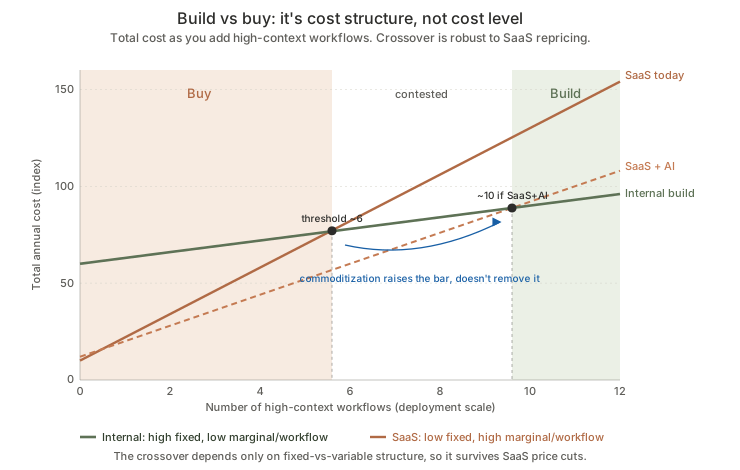
Below some number of high-context workflows, renting is simply cheaper, and you should keep buying. Above it, owning pulls ahead, because the fixed cost is now spread across enough use cases to beat per-workflow rental. This is the reason the strategy is selective rather than universal — it earns its keep only once an organization has the workflow volume, the data maturity, and the discipline to clear the threshold. And the most common objection, that all of this evaporates the moment vendors embed AI and cut prices, turns out to be wrong in an instructive way. Cheaper SaaS lowers the slope of the rental curve, which pushes the crossover to the right; you need more workflows to justify building. But it never removes the crossover, because no price cut converts variable cost into fixed cost. Commoditization raises the bar. It does not dissolve the decision.
Proving it honestly
A threshold is only useful if you can tell whether you have crossed it, and that is a question of return, not rhetoric. The trap is to measure return in the currency of productivity theater — the vague, unfalsifiable claim that AI made everyone faster. The honest test is narrower. Not “did AI create magic productivity?” but “did the cost of delivering the next high-context workflow fall as adoption grew?” If it did, the platform is starting to compound. If it did not, ownership has not won yet, and you should keep renting until it does.
When you model that return across the transition, two things come into focus.
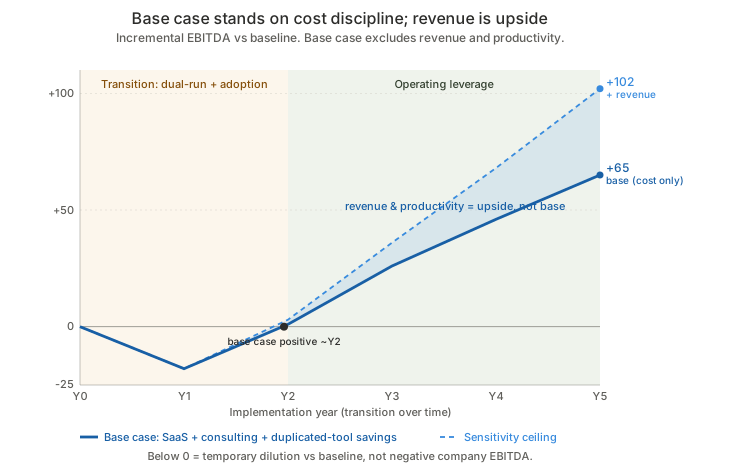
The first is that the early years dilute. While the organization carries both the old SaaS footprint and the new platform investment, incremental return goes negative before it turns — a transition cost that honesty requires you to show rather than bury. The second, and the more important, is where the case is allowed to rest. The solid line is cost discipline alone: SaaS rationalized, consulting reduced, duplicated tools removed, cost per workflow falling. The dashed band above it is revenue and productivity upside — real, but soft, and easy to delete. The discipline is to build the base case on cost alone, so that revenue only widens the margin rather than holding it up. A case that survives the deletion of its softest input is a case you can take in front of a CFO.
This demands one concession most AI pitches quietly avoid. Internal AI spend rises in absolute terms — talent, infrastructure, governance, and compute are not free, and they grow with use. What falls is cost per workflow. Owning is not a promise that the bill shrinks. It is a claim that the bill stops scaling in lockstep with everything you ask of the system.
How the load gets carried
None of this is real unless the architecture makes it real, and the architecture that does the work is hybrid. Frontier models, rented by API, take the rare and the hard: the complex reasoning, the development, the cases where capability matters more than cost. A locally owned model carries the high-volume, routine work inside a private environment, where the marginal cost of inference approaches zero and the data never leaves the building. A routing layer decides, request by request, which path to take.
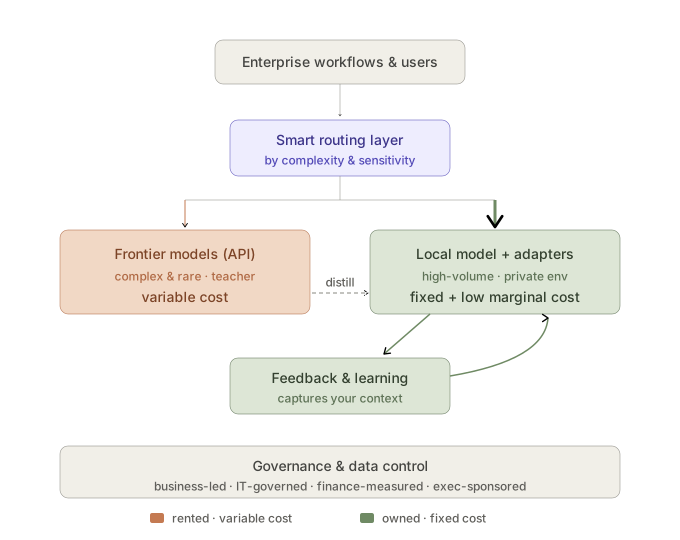
That split is not a budget trick. It is the physical reason cost per workflow falls — the bulk of the volume rides fixed-cost infrastructure while only the exceptions pay rental rates. And the quietest element in the diagram is the most durable one. The feedback loop, where production use becomes captured corrections and retrained adapters, is the place your own context compounds into the system over time.
A vendor can match the model. It cannot match your data, your decisions, and the way your business actually runs.
It is worth being exact about what “own” means here, because it is not everything. The foundation model underneath is licensed or self-hosted, never truly owned. What you own are the layers above it — the orchestration, the context, the governance — and the freedom to swap the model out as the field moves. That is not a weakness in the argument; it is the point of it. When the model layer commoditizes, the owner rides the improvement down the price curve instead of being trapped on a vendor’s roadmap.
One argument, not three
It would be easy to read the structure, the economics, and the architecture as three separate claims. They are one, and they interlock in a single direction.
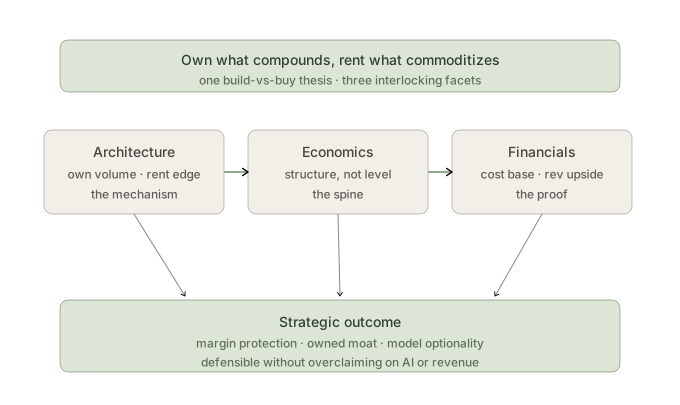
The architecture produces the cost structure — routing volume onto fixed-cost infrastructure is what makes the low marginal cost real rather than asserted. The cost structure produces the financial shape — the opposing slopes of fixed and variable cost are why the run-rate eventually drops below the rental baseline. And the financial discipline is what makes the case defensible enough to fund the architecture in the first place, which closes the loop. Pull any one out and the others weaken. Economics without architecture is a spreadsheet fantasy. Architecture without discipline is shadow IT. Financials without the structural spine is a cost-cutting exercise any procurement team could run on its own.
The honest limits
An argument is strongest when it states its own boundaries, and this one has several. It works only for organizations that clear the threshold; for most small and simple cases, renting remains the right answer, and any low-context workflow will eventually become a commodity feature you should never have built. The durable advantage is the proprietary context, the data sovereignty, and the optionality — not better AI, which vendors will always catch up to. The numbers in these figures are illustrative shapes, not forecasts; the real ones come from contract-level costs and your own adoption curve, and they should be validated before any of them is quoted. And the scarcest ingredient is not the technology at all. It is the person who can stand in the gap between business outcomes, financial impact, workflow design, model behavior, and governance — which is also a concentration of risk that good governance has to institutionalize rather than pretend away.
Which brings the whole argument back to where it began, and to the only question that really matters. The strategic question is no longer which software to buy. It is which layers of intelligence are too proprietary, too contextual, or too economically important to rent. The cost math is how you prove the answer. But the reason the answer matters is not cost at all. It is that owning the layer is what keeps the judgment, the context, and the understanding inside your business — with the people who actually do the work — instead of renting them back, a little more expensively, every year. The model can carry the load. The understanding stays yours.
The index figures in this post are illustrative — chosen to show structure and direction, not to forecast magnitudes. The cost-structure figure is indexed to workflow count; the EBITDA figure to implementation year. Both should be set to a specific organization’s real costs and adoption before any number leaves the page.